Anti-fog polycarbonate sheet: a complete guide to coatings, applications, and how to choose the right one?
Your safety visors fog up instantly in cold weather. Blind workers face terrible accidents daily. You must pick the right anti-fog polycarbonate sheet to save their vision.
Anti-fog polycarbonate sheets use special hydrophilic chemical coatings. These coatings force water vapor into a flat clear film instead of blurry droplets. You must match the exact coating type to your specific humidity level, certification needs, and factory manufacturing processes.
You might buy a standard cheap anti-fog plastic sheet right now. This cheap plastic will fail during your hot factory molding process completely. I will explain exactly how to buy the correct chemical coating for your specific product safely.
How does hydrophilic anti-fog technology actually work on plastic?
Standard raw plastic pushes water into tiny foggy drops. The user goes blind immediately. You must understand how hydrophilic chemistry fixes this dangerous physical problem completely.
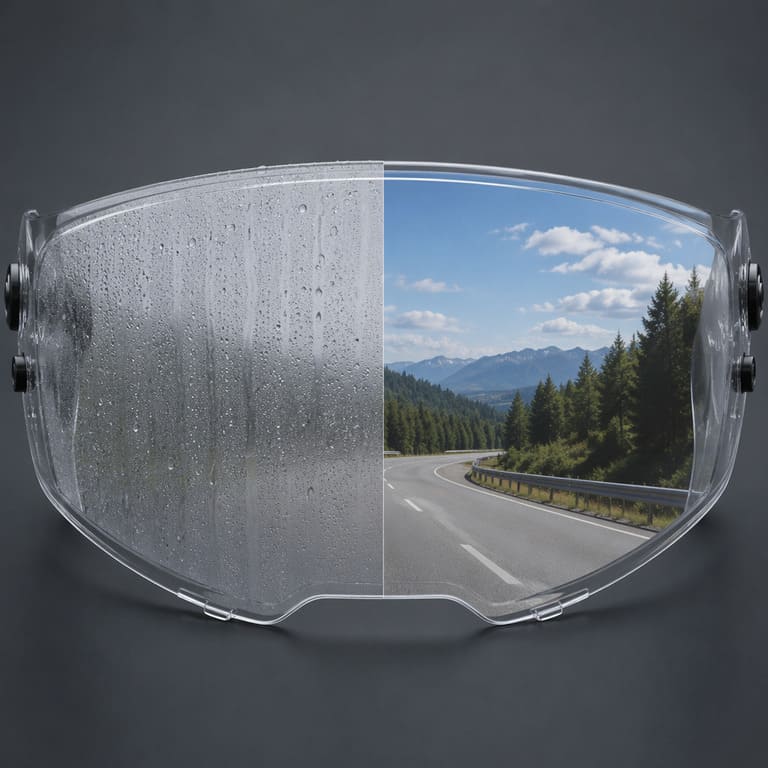
Hydrophilic anti-fog coatings lower the water contact angle below ten degrees.1 The chemical surface grabs tiny water vapor drops firmly. It spreads the water into one continuous flat transparent film. The light passes through this flat film clearly without scattering.
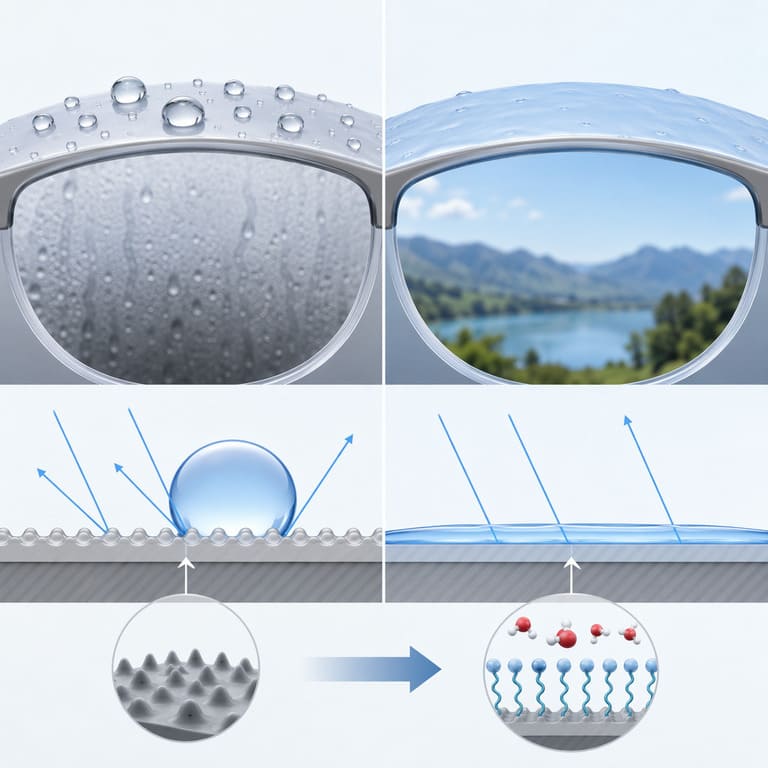
Bare polycarbonate material naturally hates water fundamentally. We call this inherent hydrophobicity in the factory. Hot breath hits the cold plastic surface quickly. The moisture forms thousands of tiny discrete water droplets. These tiny droplets scatter the incoming light wildly. The human eye sees this light scatter as thick white fog.
We apply hydrophilic chemical coatings to stop this light scatter. The chemical surface contains special active groups. These groups pull water strongly. The water contact angle drops between eight and twenty-two degrees. The water spreads flat. But this chemical sponge has a physical limit. A hydrophilic coating absorbs moisture constantly in high humidity environments. The coating reaches total water saturation eventually. The anti-fog effect stops working after saturation. The local weather heavily decides the coating lifespan directly. A normal anti-fog coating lasts two years in a dry environment safely. That exact same coating only lasts six months in a wet heavy jungle. You must tell us your exact product location early. We can formulate long-lasting chemical mixtures with plasma modification to fight heavy humidity.
| Environment Type | Average Coating Lifespan | Core Chemical Problem |
|---|---|---|
| Dry Indoor Room | 1 to 2 years | Very low saturation risk |
| Wet Outdoor Jungle | 6 to 12 months | Fast water saturation |
Why do tough military and fire safety masks require strict EN166 certification?
Cheap anti-fog coatings wash off quickly in heavy rain. Firefighters lose their vision inside burning buildings. You must demand strict chemical testing for true life safety.
Extreme safety gear requires the strict EN166 "N" mark certification for anti-fog performance. You must use pure optical grade polycarbonate base materials. The factory must apply long-lasting composite polymer coatings to guarantee clear vision during extreme emergency situations.
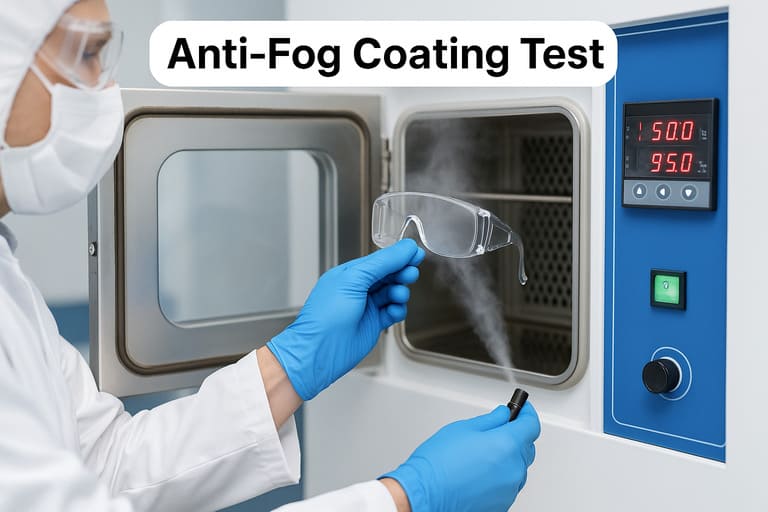
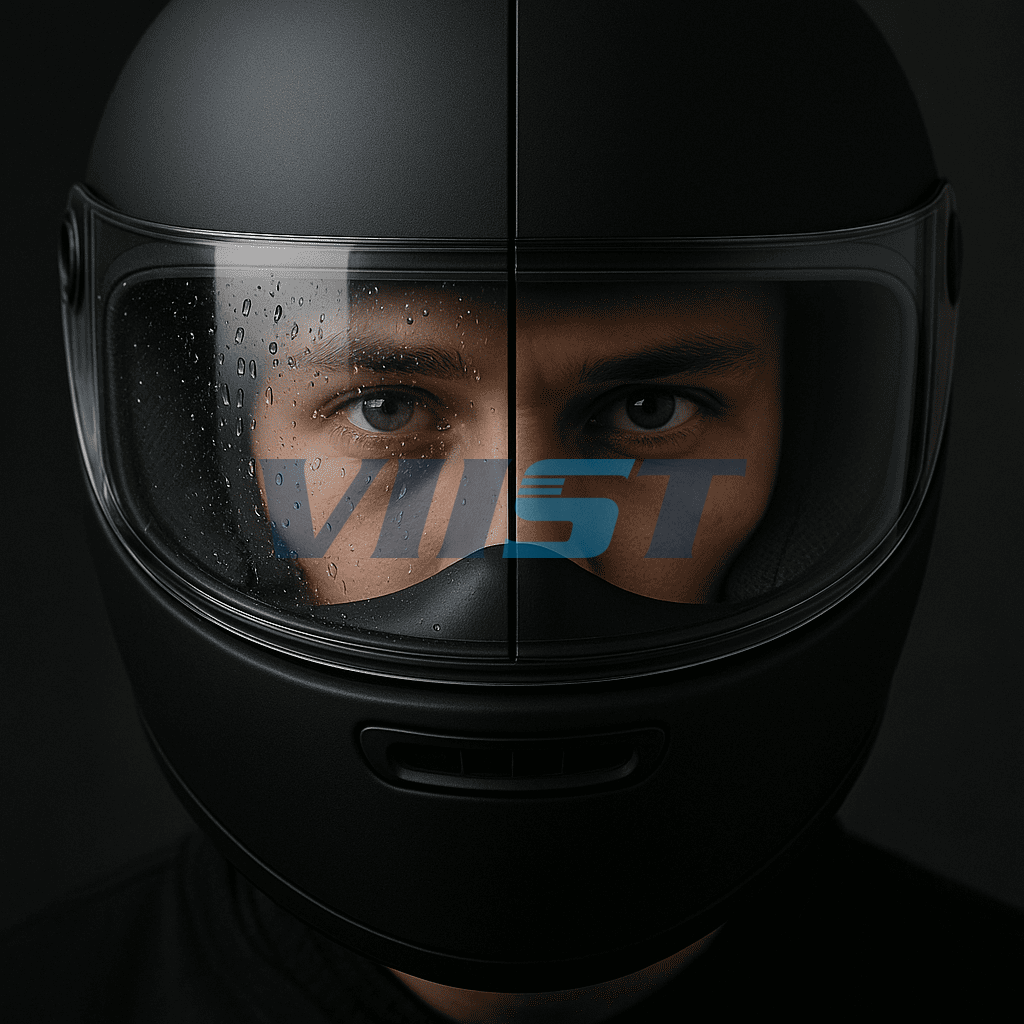
We handle heavy military and fire safety projects at VIIST constantly. A blind firefighter cannot save lives. The anti-fog coating directly decides human survival. You cannot use normal cheap coatings for these extreme danger jobs. We must build highly precise chemical formulas. We use strict plasma modification directly on the plastic. We add tough hydrophilic polymers on top.
We must also start with perfect base materials completely. We only use pure optical grade polycarbonate sheets. A cheap dirty plastic base ruins the high-end chemical coating instantly. We recently built a heavy gas mask visor for a major safety client. We applied a tough hard scratch coating on the outside. We applied a permanent anti-fog coating on the inside. Both separate sides passed the strict EN166 standard tests perfectly.
| Safety Mask Type | Required Standard | Inside Coating | Outside Coating |
|---|---|---|---|
| Standard Daily Goggle | Basic general test | Normal Anti-fog | Normal Hard Coat |
| Fire / Gas Mask | EN166 "N" Mark | Premium Long-lasting | High Wear-Resistant |
You must tell your supplier about your certification goals on day one. We use completely different expensive chemicals to pass these strict European safety laws.
Will your factory post-processing ruin the new anti-fog chemical coating completely?
You buy perfect anti-fog plastic sheets from us. Your factory prints logos on them and melts them. The chemical coating cracks and fails entirely.
Post-processing methods like hot thermoforming and silk printing destroy standard anti-fog coatings. Thermoforming melts the plastic at high heat and cracks normal chemicals. Silk printing requires specific surface dyne levels.2 You must buy special compatible chemical formulas for these factory steps.
Many buyers forget to tell me about their own factory processes entirely. This silence creates a massive disaster later. We finish the anti-fog coating on flat polycarbonate sheets here. We ship the flat clear sheets to the customer. The customer then puts the flat sheets into a huge hot oven. They bend the sheets into curved safety helmets. This process uses heavy thermoforming. The oven heats the plastic to one hundred and eighty degrees heavily. A standard anti-fog chemical coating simply burns and cracks at this high heat. We must use a special high-temperature coating formula if you want to bend the plastic later.
Customers also print dark ink logos directly on the clear visors. The anti-fog coating heavily changes the natural plastic surface energy. A normal anti-fog surface repels wet ink instantly. The logo simply falls off. We must adjust the surface dyne level carefully. The adjusted coating grabs the silk screen ink safely.
| Post-Processing Step | Factory Action | Required Coating Modification |
|---|---|---|
| Thermoforming | High heat bending (150-180°C) | High-temperature flexible formula |
| Silk Printing | Wet ink application | Specific surface dyne level |
Always explain your full factory plan to us. We will match the raw chemistry to your hot machines.
How do we accurately test the anti-fog coating for true daily reliability?
You receive a new batch of coated plastic sheets. You do not know if the coating actually works. You must test the chemical surface deeply.
You can run a simple breath test for fast daily checks. You breathe heavy hot air onto the plastic and watch the fog disappear. Real laboratory validation requires strict accelerated aging tests and long cycle testing under EN166 or ASTM D7868 rules.
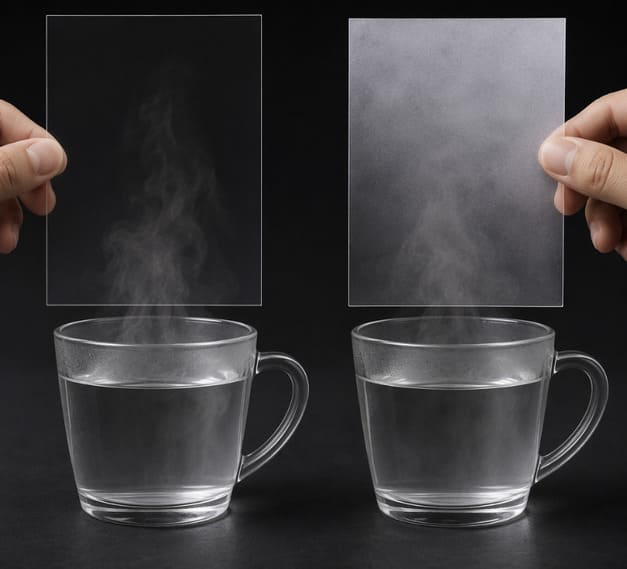
You need simple ways to check your raw materials on the factory floor. The hot breath test acts as the fastest local method perfectly. You hold the plastic sheet closely. You breathe heavy hot air directly onto the clear surface. You watch the water vapor carefully. A bad coating creates thick white fog instantly. A good coating stays completely clear. The tiny water film dissipates very quickly.
But this simple breath test cannot prove long-term survival. We must use massive lab machines for true quality guarantees. We run heavy accelerated aging tests. We put the plastic inside wet hot chambers for many weeks. We follow strict EN166 and ASTM D7868 test rules constantly.
You must give us a complete requirement list early. Tell us your exact humidity environment completely. Pick your required coating lifespan clearly. List your specific factory post-processing steps honestly. Choose your safety certification level firmly. Select true optical grade raw plastic heavily. We design the exact chemical solution for your exact product needs with this clear list.
| Test Method Name | How You Do It | What It Actually Proves |
|---|---|---|
| Human Breath Test | Breathe hot air onto plastic | Shows basic chemical presence fast |
| Accelerated Aging | Use hot wet lab chambers | Proves long-term environmental survival |
| EN166 / ASTM D7868 | Strict machine cycle testing | Guarantees legal safety compliance |
You must match your anti-fog coating clearly to your daily environment, legal safety certifications, and hot factory processes to guarantee permanent clear vision for your exact product.
"(PDF) Characterization of Multilayer Anti-Fog Coatings", https://www.academia.edu/21701986/Characterization_of_Multilayer_Anti_Fog_Coatings. A review of antifogging coatings explains that superhydrophilic surfaces reduce water contact angle and promote sheet-like condensation rather than droplet formation. Evidence role: mechanism; source type: paper. Supports: Hydrophilic anti-fog coatings reduce water contact angle to a very low value.. Scope note: The source can support the mechanism and typical contact-angle concept; it may not prove that every commercial coating reaches below ten degrees. ↩
"Flexography Printing Performance of PLA Film", https://digitalcommons.calpoly.edu/cgi/viewcontent.cgi?article=1036&context=it_fac. Printing and surface-treatment references use dyne level or surface energy measurements to assess whether a plastic surface has adequate wetting for ink adhesion. Evidence role: mechanism; source type: institution. Supports: Surface dyne level is relevant to ink wetting and adhesion in printing on plastics.. Scope note: The required dyne level varies by ink chemistry, substrate, and printing process. ↩