
How do you test anti-glare (AG) coating on custom glass covers?
Struggling with screen glare on your display cover glass? Mis-specifying the anti-glare coating can ruin display clarity and the user experience. Learn the four key tests to get it right every time.
To properly test an anti-glare(AG) coating, you must measure four key optical parameters: Haze, Gloss, Distinctness of Image (DOI), and Sparkle. Evaluating these metrics together ensures you achieve the perfect balance between glare reduction and high display clarity for your custom glass cover.
Many displays are protected by a cover lens. This isn't just a simple piece of glass; it's often treated with special coatings for scratch resistance, anti-reflection, and anti-fingerprint functions. But knowing if your supplier has met the specs, especially for anti-glare, is crucial. Today, I'm going to walk you through the performance indicators for AG coatings. We'll get into anti-reflection (AR) and anti-fingerprint (AF) in future articles.
From light scattering to optical distortion: what are the 4 key metrics to qualify AG on a cover lens?
You're looking at a spec sheet filled with AG terms like Haze1 and DOI2. It's confusing, and choosing wrong leads to a subpar display. Let's demystify the four metrics now.
The four essential metrics for qualifying an anti-glare (AG) coating are Haze, Gloss3, Distinctness of Image (DOI), and Sparkle4. These parameters quantify the coating's ability to scatter light, its surface shininess, its impact on image clarity, and any resulting visual graininess or "noise."
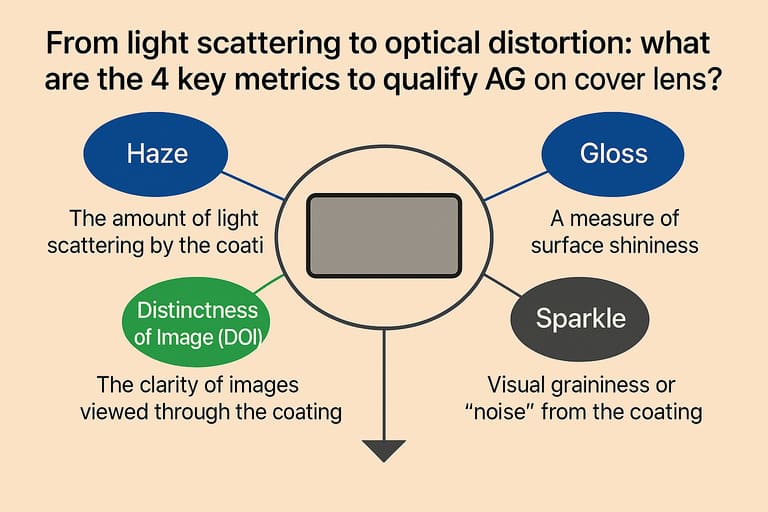
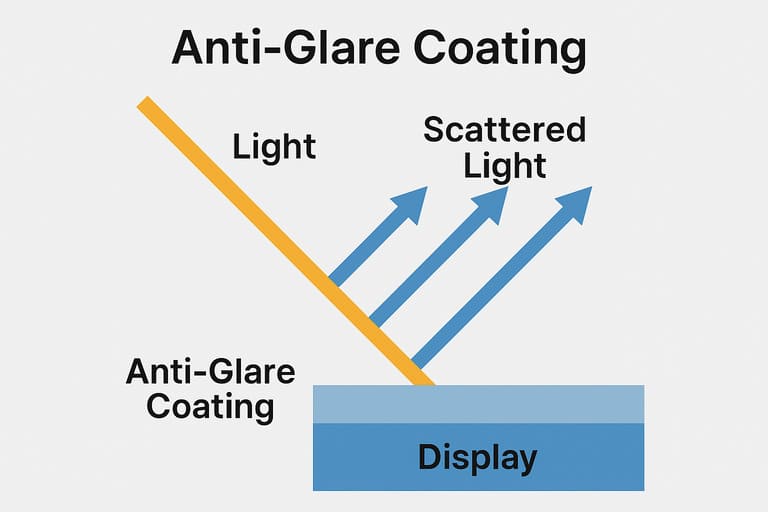
In my experience, the core of a good AG coating is creating a micro-scratched or rough surface. This texture scatters reflected light, which is what eliminates that annoying mirror-like glare. However, this same texture can interfere with the light coming from the display itself. To find that perfect balance, manufacturers and engineers need a common language. That language consists of four key parameters. When you specify an AG coating, you're really trying to find the ideal formula by adjusting these four variables to match your display. Let's break them down.
AG Performance Metrics Explained
| Metric | What It Measures | Why It Matters for Your Display |
|---|---|---|
| Haze | The percentage of light scattered by the coating. | This is your primary anti-glare weapon. More haze generally means less glare. |
| Gloss | The specular reflectivity or "shininess" of the surface. | A direct measurement of how much mirror-like reflection remains. Lower gloss is a key goal of AG coatings. |
| DOI (Distinctness of Image) | The clarity of a reflected image on the surface. | Measures how much the AG coating distorts reflections. A lower DOI means reflections are blurrier, which is desirable. |
| Sparkle | A grainy or shimmering effect seen on illuminated pixels. | This is an unwanted side effect. A high sparkle value makes the display look "sandy" and low-quality. |
Why isn’t higher haze always better for balancing AG performance?
You asked for high haze to kill glare, but now your screen looks foggy and washed out. Chasing a single metric is a common trap. Let's find the sweet spot for a crystal-clear display.
Higher haze isn't always better because excessive light scattering degrades the display's own image quality. Once haze exceeds a certain threshold (e.g., >20-30%), it causes noticeable fogginess, reduced contrast ("washed out" blacks), and a shimmering sparkle effect, ruining visual clarity.
I’ve seen clients fall into this trap many times. They think that since haze reduces glare, maximum haze must be the best solution. That’s rarely true. Technically, transmission haze is the percentage of light that, after passing through the glass, scatters more than 2.5 degrees away from its original path. A higher percentage means more scattering and a stronger anti-glare effect. However, haze has a "comfort zone" and significant side effects. When you push it too far, especially on high-end touchscreens, you create new problems.
The Problems with Excessive Haze
- Optical Distortion: The whole screen can appear "whitewashed" or foggy. Small text and icons lose their sharp edges and can appear to have a soft halo around them.
- Increased Sparkle: The AG texture can interact with the pixel grid of the display, creating a distracting grainy or shimmering effect. I’ll discuss this more later.
- Lower Contrast & Readability: The display's black levels suffer, making them look like dark gray instead of true black. This ironically can make the screen less readable in bright light, defeating the purpose of the anti-glare coating.
How do you stop guessing and use DOI and Sparkle to define AG quality?
Your cover glass has the target haze, but it still looks grainy or distorted. You're missing the two final quality checks. DOI and Sparkle are the metrics that matter for premium products.
You use DOI and Sparkle to judge the trade-offs of the AG coating. DOI directly measures reflection clarity; a moderate value (e.g., 20-40) is good. Sparkle measures visual noise; it must be low for a clean image. These two metrics define a high-quality, premium finish.
Here’s the practical advice I give to all my clients: Start by setting a target haze range (for example, 10-18% for a high-end touchscreen), not a single number. Once you're in that range, shift your focus to DOI and Sparkle. These two parameters are often the real bottlenecks for achieving a premium look and feel, and they reveal a manufacturer's true process control.
DOI: Finding the Right Amount of Blur
DOI directly measures the quality of a reflected image. High-performance touchscreens shouldn't have a perfect mirror reflection, but you also don't want the screen content to become blurry. A moderate DOI (often 20-40) is the sweet spot. It's enough to blur distracting reflections without distorting the actual display image underneath.
Sparkle: The Premium Killer
Sparkle is that "sandy" or "glittery" texture you see on some AG screens. It’s a huge distraction and makes a product feel cheap. Minimizing sparkle is non-negotiable for a premium device. This is controlled by carefully tuning the manufacturer's etching or spray coating process (controlling the particle size and uniformity) or by using specialized anti-sparkle additives in the coating formula. A supplier that can deliver low sparkle at your target haze is a supplier you can trust.
Conclusion
Testing AG coating isn't about one number. It's about balancing Haze, Gloss, DOI, and Sparkle. This balanced approach ensures you eliminate glare without sacrificing the brilliant clarity of your display.
"[PDF] display metrology issue", https://tsapps.nist.gov/publication/get_pdf.cfm?pub_id=32864. A standards-based optical-measurement source can substantiate that haze is a standard parameter for quantifying the fraction of transmitted light scattered away from the incident beam, making it relevant to evaluating anti-glare display cover coatings. Evidence role: definition; source type: institution. Supports: Haze is a key optical parameter for qualifying an anti-glare coating because it measures the percentage of light scattered by the coating.. Scope note: This supports the definition and relevance of haze as an optical scattering metric; a separate source may be needed to verify the full four-metric qualification framework including gloss, DOI, and sparkle. ↩
"Distinctness of image - Wikipedia", https://en.wikipedia.org/wiki/Distinctness_of_image. A technical standard or peer-reviewed optical-metrology source defining Distinctness of Image (DOI) as the sharpness or clarity of a reflected image on a surface would substantiate DOI’s use as a measure of reflection clarity and optical distortion in anti-glare coatings. Evidence role: definition; source type: other. Supports: DOI (Distinctness of Image) measures the clarity of a reflected image on the surface and indicates how much an anti-glare coating distorts reflections.. Scope note: General DOI standards often address coated or glossy surfaces broadly; an additional display-specific source may be needed to connect DOI directly to anti-glare cover glass performance. ↩
"[PDF] Methods of determining gloss - NIST Technical Series Publications", https://nvlpubs.nist.gov/nistpubs/jres/18/jresv18n1p19_A1b.pdf. A standards-based optics source defining gloss as the specular, mirror-direction reflectance or perceived shininess of a surface supports using gloss to quantify residual mirror-like reflection from an anti-glare coated cover glass. Evidence role: definition; source type: institution. Supports: Gloss is an essential anti-glare coating metric that measures the surface’s specular reflectivity or shininess, indicating how much mirror-like reflection remains.. Scope note: Gloss depends on measurement geometry and surface/material context, so it supports the definition of the metric rather than the full performance specification for any particular display. ↩
"Optimization of Process Parameters for Anti-Glare Spray Coating by ...", https://pmc.ncbi.nlm.nih.gov/articles/PMC6427158/. Peer-reviewed optical metrology literature describes display “sparkle” as a grainy or shimmering luminance non-uniformity that can arise when light from a pixelated display interacts with an anti-glare surface microstructure, supporting its use as a display-quality metric. Evidence role: definition; source type: paper. Supports: Sparkle is a grainy or shimmering visual-noise effect seen on illuminated pixels and is one of the key metrics used to qualify anti-glare coating quality on display cover glass.. Scope note: The source should support the definition and relevance of sparkle; acceptable sparkle thresholds vary by display design, pixel density, viewing conditions, and test method. ↩