How to measure anti-reflection (AR) coating performance on custom glass covers?
Screen reflections hide your display content. You lose users and waste money on poor coatings. Let us learn how to measure anti-reflection (AR) coating performance correctly.
You measure AR coating performance by evaluating three core factors. First, you test optical metrics like transmittance and reflectance using a spectrophotometer. Second, you check the specific wavelength range. Third, you examine the residual color of the glass.
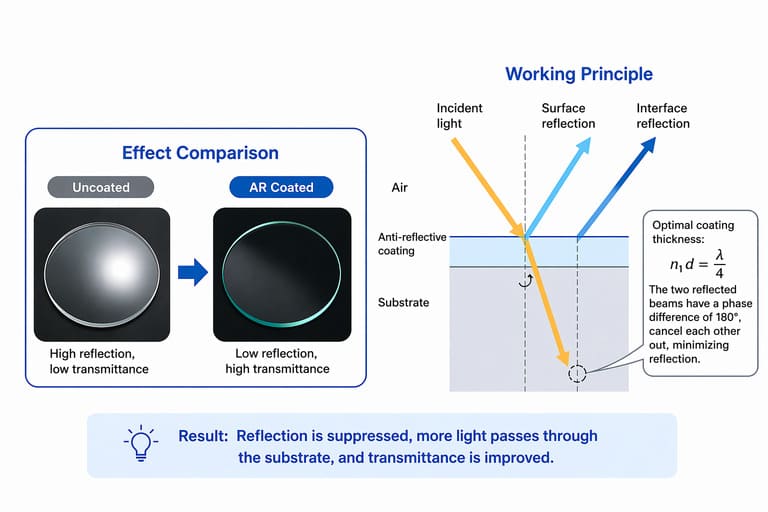
I explained AG coatings in my last post. Today, we will focus completely on anti-reflection (AR) coating. We will look at exact test methods so you can stop bad reflections from ruining your next device.
What are the 5 key optical metrics you must test for an AR coating?
A high reflection rate makes a screen impossible to read. If you skip careful testing, you get a useless display. You need specific numbers to guarantee quality.
You test five optical metrics with a spectrophotometer. These are reflectance, average reflectance, minimum reflectance, transmittance, and maximum transmittance. A good double-sided AR coating pushes transmittance over 95% and drops reflectance below 0.5%.
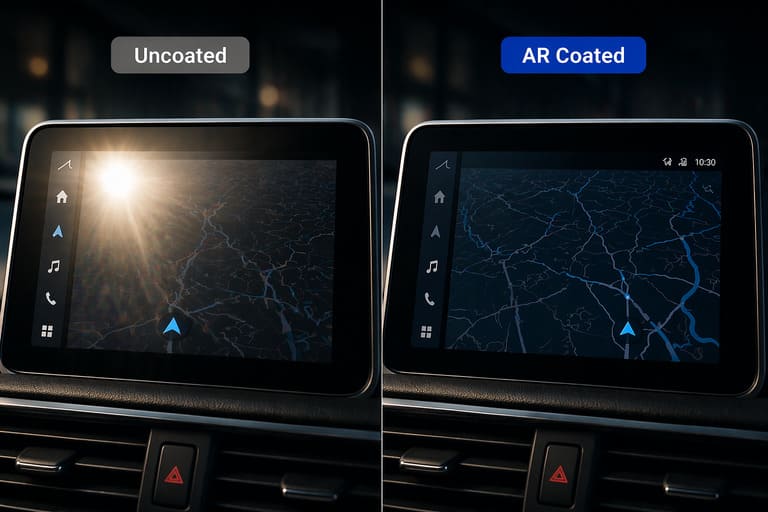
I always tell my customers that data is the only truth. Before an engineer starts production on a custom glass cover, they need to know your exact rules for light transmittance and maximum reflectance. You use a machine called a spectrophotometer to find these numbers. We look at five specific data points to judge success.
First is reflectance. This is the ratio of reflected light compared to total light. A single-sided AR coating must stay under 1.5%. A double-sided coating must stay under 0.5%. Second, we look at average reflectance across a specific band. For visible light, this should be under 1%. Third is minimum reflectance. This is the lowest number in that band. We usually target 550 nanometers. This is because the human eye is most sensitive at 550 nanometers. Fourth is transmittance. This is the light that goes through the glass to your eye. Normal bare glass is about 91% or 92%. A good AR coating raises this above 95%. Finally, maximum transmittance is the highest peak of light allowed through. This peak can reach over 98% on a great AR cover lens.
Key Optical Metrics for Custom AR Cover Lenses
| Optical Metric | Simple Definition | Standard Target Value for Production |
|---|---|---|
| Reflectance | Ratio of light bouncing off the glass | Single-side <1.5%, Double-sided <0.5% |
| Average Reflectance | Average reflection inside the target band | < 1% (in the 400-700nm visible range) |
| Minimum Reflectance | The lowest reflection point found | Usually targeted at 550nm for human eyes |
| Transmittance | Ratio of light passing through the glass | > 95% (Note: Bare glass is only 91-92%) |
| Maximum Transmittance | The top peak of light passing through | Generally > 98% at peak |
Why is defining the wavelength range the first step to customize AR coatings?
You want an invisible glass cover to create a perfect screen. But a random AR coating will fail on your specific device. You must define your light range first.
You define the wavelength range because different applications use different light. A common consumer display needs visible light optimization from 400 to 700 nanometers. But an optical lens needs a wider range like 400 to 1000 nanometers to work well.
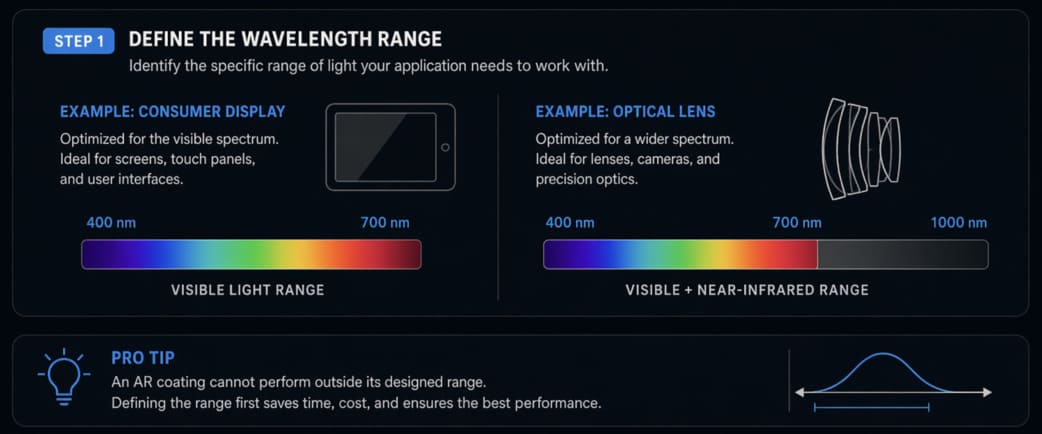
When you start a new custom project, you must tell your supplier exactly where the glass will be used. A professional coating engineer uses this information to find your exact wavelength range. If you do not know the exact numbers, just tell us the application. We will design the formula for you. The working band is simply the range of light waves that the customer needs to optimize.
For most standard touchscreens and consumer electronics, we optimize for visible light. This band is between 400 and 700 nanometers. Sometimes we make it wider, from 380 to 780 nanometers, to include some near-ultraviolet light.Automotive display coverglass are very different. They need good visibility for human drivers, but they also use sensors. So, we adjust the AR coating for visible light plus some near-infrared bands. Optical lenses and security cameras lens cover go even wider. They often stretch from 400 up to 1000 nanometers. Laser protection windows require very narrow, exact bands, like 532 nanometers or 1064 nanometers.
Common Wavelength Ranges for Specific Applications
| Product Application | Target Wavelength Band | Primary Focus for the Device |
|---|---|---|
| Standard Displays | 400 - 700nm | Pure visible light for human eyes |
| Automotive Monitors | Visible + Near-Infrared | Human sight and car sensor systems |
| Optical Lenses | 400 - 1000nm | Visible and Near-Infrared light combined |
| Laser Window Covers | Specific narrow bands | Blocks specific lasers (e.g., 532nm only) |
Why does an AR coated display cover glass show purple or green residual colors?
Customers see a purple tint on the glass when the light hits it. They worry it is a bad batch. This color is actually optical science in action.
Residual colors happen because of the optical interference principle.1 An AR coating has thin layers that cancel main reflections. But it cannot stop all light waves. A small amount of light reflects back. This remaining light creates colors like blue-purple or green.
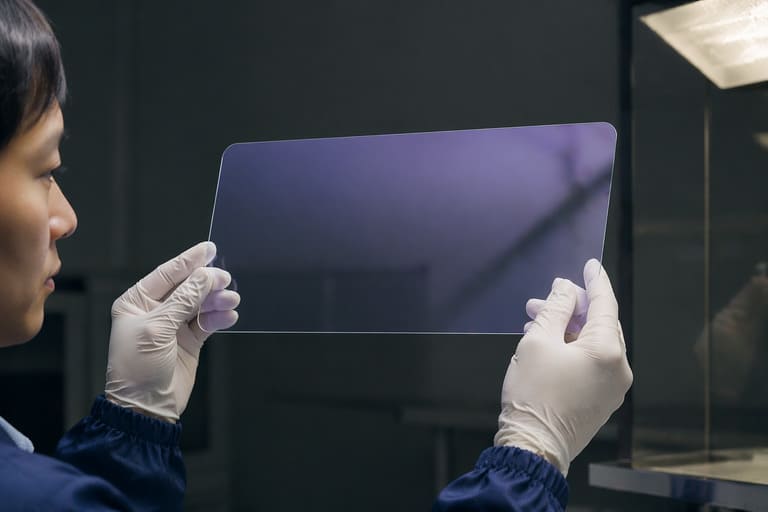
If you look at an AR coated glass under a standard lamp, you will see a color reflection. The most common colors are blue-purple, green, or a neutral gray. Very rarely, it might look slightly red. This is completely normal and shows the coating is working. AR coatings work based on the optical interference principle. It is exactly like the rainbow colors you see on the surface of a soap bubble.
The AR coating is made of multiple layers of materials. These materials have different refractive indexes. They are stacked on top of each other. Every single layer reflects a tiny piece of light. These small reflections interfere with each other. The design forces most light waves to cancel each other out. That stops the glare. But we cannot eliminate 100% of all reflections. The small amount of light that survives is what you see. We call this residual color. By adjusting the materials, the layer count, or the layer thickness, engineers can customize this color. At VIIST, we look at your final product and suggest the best color for your design.
Customizing AR Residual Colors for Your Project
| Residual Color Observed | Visual Characteristics | Best Applications |
|---|---|---|
| Blue / Blue-Purple | Most common type. Good overall performance. | Consumer electronics, general display screens |
| Green | Extremely low reflection rate. Highly sensitive path. | High-end camera lenses, professional displays |
| Neutral / Gray | Most "invisible" look. Does not change screen color. | Medical displays, premium automotive screens |
| Slightly Red | Very rare. Blocks or passes very specific bands. | Special optical devices and sensors |
Conclusion
Measuring AR coatings requires checking optical metrics, setting the correct wavelength range, and choosing the right residual color. Use real data to get perfect, anti-reflective custom glass covers.
"Anti-reflective coating - Wikipedia", https://en.wikipedia.org/wiki/Anti-reflective_coating. Thin-film optics references explain that interference between light reflected from multiple interfaces in a coating produces wavelength-dependent reflection, which can appear as residual color. Evidence role: mechanism; source type: education. Supports: Residual colors in AR-coated glass arise from optical interference.. ↩