AG vs AR coating on glass covers — what’s the difference and when to use which?
Are you confused about AG and AR coatings? Picking the wrong one wastes your budget and ruins display clarity. Let us clear up the confusion today.
AG (anti-glare) and AR (anti-reflection) coatings solve screen visibility differently. AG uses a rough surface to scatter incoming light and reduce harsh glare. AR uses nanoscale optical interference layers to let more light pass through and stop reflections.
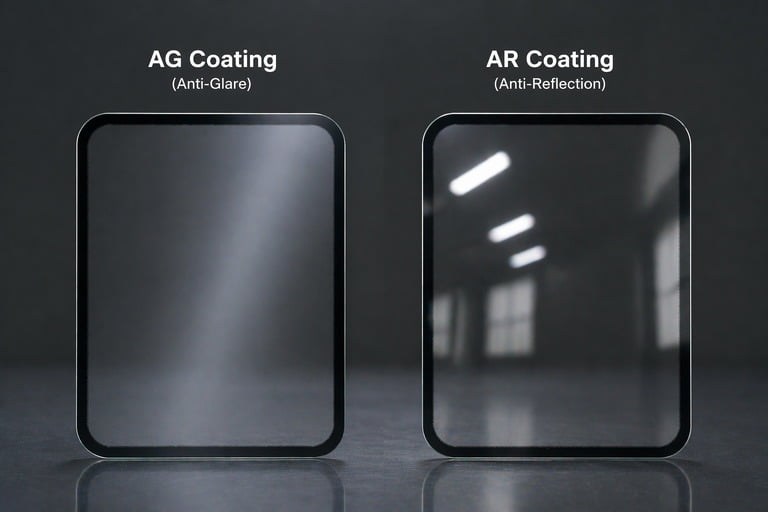
Many clients mix up these two concepts. You need to understand the core differences between them to make strong product choices. This guide will help you select the exact right coating and optimize your funds.
How does anti-reflection (AR) coating use optical interference1 to boost screen clarity?
Your device screen looks dim and acts like a mirror outdoors. That setup frustrates users. AR coating fixes this by letting maximum light reach the eye.
AR coating uses the principle of optical interference. It places nanoscale layers of metallic oxides on the glass. These layers cancel out reflected light waves. This increases light transmittance and dramatically improves outdoor visibility for lenses and screens.
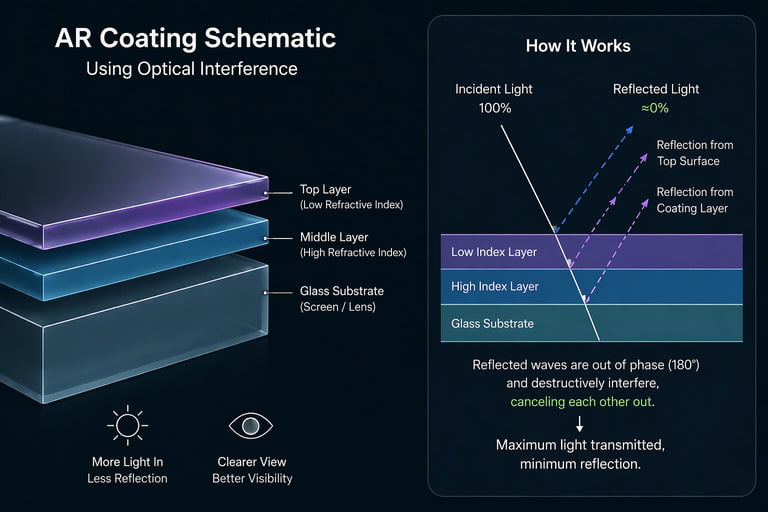
I often see engineers struggle with thick, dark device covers. They try to make the screen backlight brighter to fight outdoor sun. This drains battery life almost instantly. I tell them to use a good AR coating instead. AR stands for anti-reflection. It relies on pure optical science. We use high and low refractive index oxide materials for this process. Common materials include TiO2, Ti3O5, MgF2, and SiO2. We stack these nanoscale layers on the base glass sheet.
These thin layers cause optical interference. The returning light waves crash into each other and cancel out completely. This interaction sinks the reflection. Because the light does not bounce back, it passes straight through the glass to the viewer. The screen image becomes very vivid and clear. This gives you amazing outdoor visibility. You will see AR coating on high-end camera lenses, vehicle instrument panels, and car dashboards. We also use it on protection covers for sensitive optical displays. Your display gets brighter without using more power. You save battery and win happy customers.
How does anti-glare (AG) coating use diffuse reflection to kill harsh light?
Staring at a glossy screen under bright warehouse lights hurts the eyes. Users cannot read important data. AG coating scatters that harsh light for easy reading.
AG coating turns a smooth, highly reflective base material into a micro-rough surface. This fine, uneven structure acts like frosted glass. It scatters incoming light through diffuse reflection. This action weakens the reflection, increases viewing angles, and prevents harsh glare.
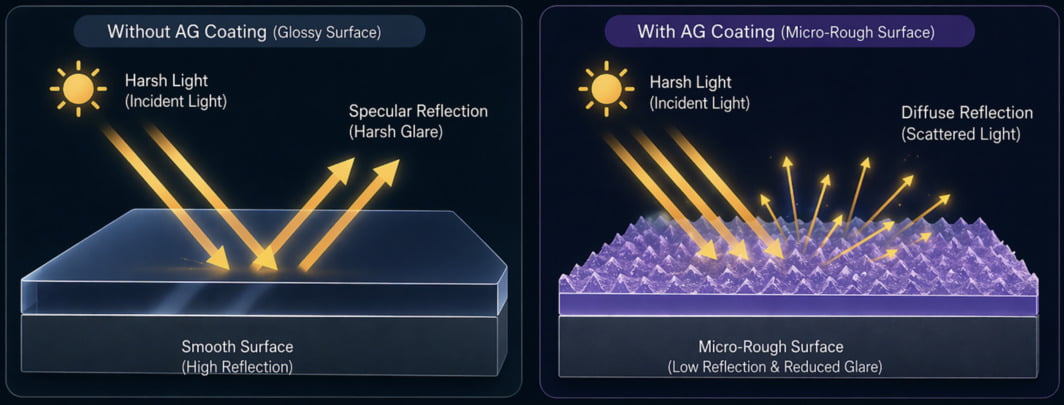
A few years ago, a client built a great digital photo frame. But under bright living room lamps, the glass looked exactly like a mirror. You could only see the lamp bulb, not the family photos. I told them they needed an AG coating. AG stands for anti-glare. It works completely differently from AR.
Instead of adding nanoscale optical layers, we change the physical surface of the substrate. We apply a special process to make the surface fine and uneven. We basically turn a shiny surface into a matte finish. When strong light hits this matte surface, it bounces in many different directions. We call this diffuse reflection. The light loses its harsh, focused intensity. The overall reflectivity drops sharply, and the blinding glare disappears completely.
This matte texture also improves the viewing angle. Multiple users can view the screen from the sides with clear images and sharp colors. AG is totally perfect for devices in strong light environments. I recommend AG for outdoor ATM panelsATM display monitors., display advertisements, digital photo frames, and heavy electrical equipment panels.
How do you choose between AG and AR to optimize your budget and display design?
You have a tight project budget and a strict screen deadline. Guessing the wrong coating wastes time and money. You must match the coating to the environment.
Choose AR coating when you need maximum clarity, extreme light transmission, and pure image quality, like on camera lenses. Choose AG coating when your device operates in harsh, direct lights and you must stop blinding glare, like on an ATM.
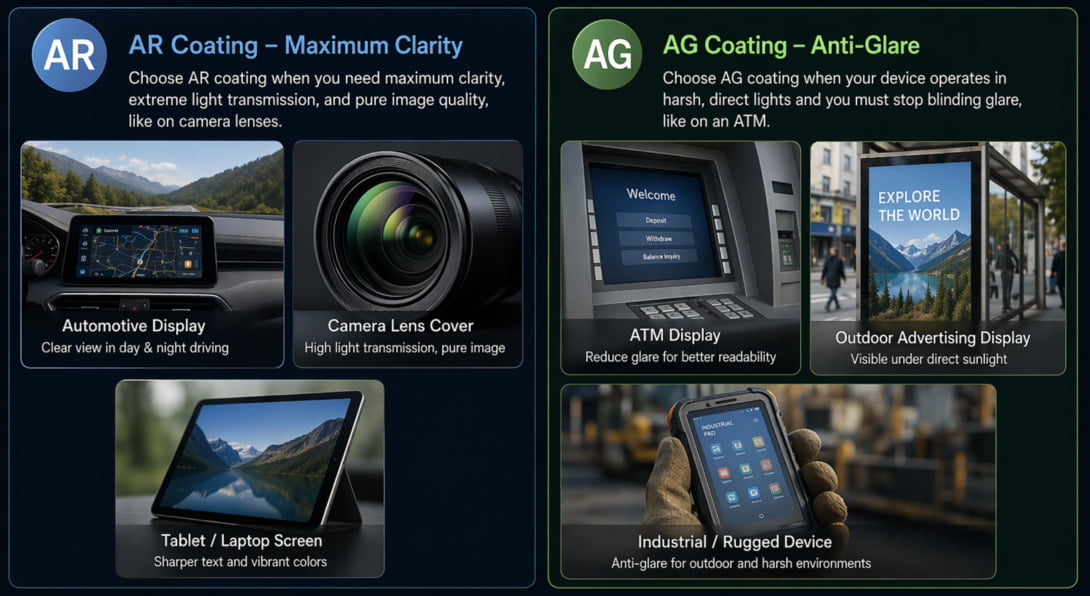
You now know how both coatings work on a technical level. The final step is making the right choice for your specific project. My job is to help you use your funds optimally. Do not buy premium AR coatings for a simple outdoor factory monitor. Do not use a frosted AG coating on a high-end camera lens. You must align the optical function with the real-world application.
Let us break down the decision process. You need to ask yourself where the user will stand and look at the screen. If they need to see fine details without color change, pick AR. If they stand in a parking lot dealing with direct sun glare, pick AG.
| Function | AR (Anti-Reflection) Coating | AG (Anti-Glare) Coating |
|---|---|---|
| Core Method | Uses nanoscale optical interference layers | Uses a micro-rough surface texture |
| Primary Benefit | Increases total light transmittance | Uses diffuse reflection to kill glare |
| Visual Look | Crystal clear, flat, invisible glass | Matte, slightly frosted appearance |
| Main Use Cases | Camera lenses, car dashboards, instrument panels | ATMs, outdoor ads, factory equipment screens |
Both coatings add immense value to your custom glass cover. Your choice dictates the final user experience. By choosing correctly, you ensure excellent display visibility and protect your project budget.
When should you combine AG and AR coatings for the ultimate display performance?
Blinding glare hurts your eyes, and washed-out colors ruin the screen image. A single coating fails in extreme conditions. Combining AG and AR coatings fixes both problems at once.
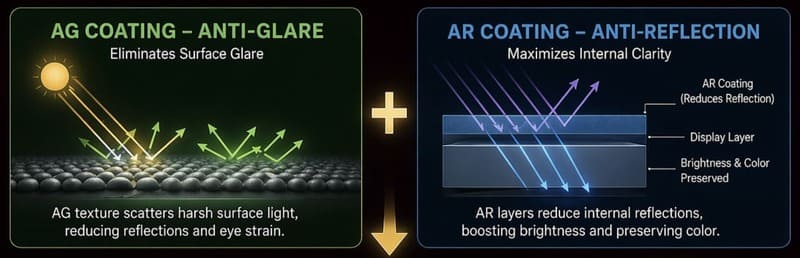
You combine AG and AR coatings when a device needs zero glare and maximum brightness at the same time. The AG texture scatters harsh surface light, while AR layers boost internal screen clarity. This dual combination is essential for premium automotive displays, military tablets, and high-end outdoor monitors.
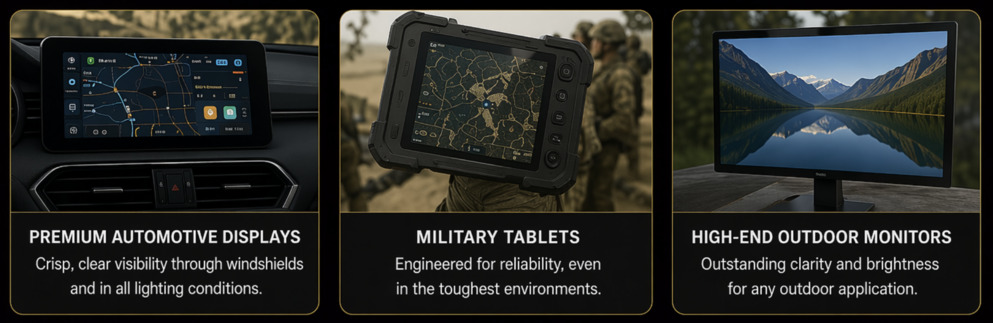
Sometimes, choosing just one coating is not enough for premium projects. I have worked with clients building luxury automotive dashboards, marine navigation screens, and rugged military tablets. In these extreme outdoor environments, you face two massive problems at the exact same time: blinding surface glare and low internal screen brightness. If you only use an AG coating, the intense sun is scattered, but the screen might look too dark or foggy. If you only use an AR coating, strong direct sunlight can still hit the screen and create a sharp mirror effect.
That is why we combine them into a single solution. We apply the fine AG texture to the top surface of the glass to scatter the direct harsh light. Then, we apply the thin AR optical layers to the glass. The AG texture completely stops the blinding glare. At the same time, the AR layers force the internal display light straight through the glass to your eyes. The result is incredible. The screen stays completely readable, highly detailed, and vivid, even under direct noon sunlight. This dual combination costs more to manufacture, but it provides the absolute ultimate visual experience for top-tier products.
When to Use the AG + AR Combination Strategy
| Application Scenario | The Visual Challenge | Why AG + AR is the Solution |
|---|---|---|
| Luxury Automotive Displays | Direct sun glare plus need for high-end color clarity. | AG stops sun blindness; AR keeps colors vivid for safety. |
| Military Rugged Tablets | Extreme outdoor light and critical data reading. | Ensures perfect readability in any battlefield lighting. |
| Marine Navigation Screens | Intense water reflection and bright sun. | Cuts water glare and boosts map brightness. |
Conclusion
AG uses a rough texture to scatter harsh glare. AR uses nanoscale layers to boost light transmission. Choose one or combine both to master screen clarity and optimize funds.
"[PDF] Antireflection effects at nanostructured material interfaces and the ...", https://sites.utexas.edu/chang/wp-content/uploads/sites/4922/2015/02/Yang_Nanotechnology_ARNI.pdf. A university optics source explaining thin-film anti-reflection coatings can substantiate that destructive interference between light reflected at coating interfaces reduces reflected intensity and thereby increases transmitted light. Evidence role: mechanism; source type: education. Supports: AR coating uses the principle of optical interference, with nanoscale layers that cancel reflected light waves and increase light transmittance.. Scope note: This supports the general optical mechanism of AR coatings, not the specific performance claims or material choices for any particular product. ↩