Scratch-resistant coating not lasting long enough? Understanding hard coating grades, curing, and durability?
Your expensive display cover gets scratched quickly after deployment. Customers complain about ruined screens constantly. You must learn how to select the right hard coating to solve this problem.
Hard coating durability depends entirely on the grade, application process, and curing method. High wear-resistant multi-layer coatings offer extreme protection. Thermal curing creates a stronger surface than fast UV curing. You must match the exact coating type to your specific product environment.
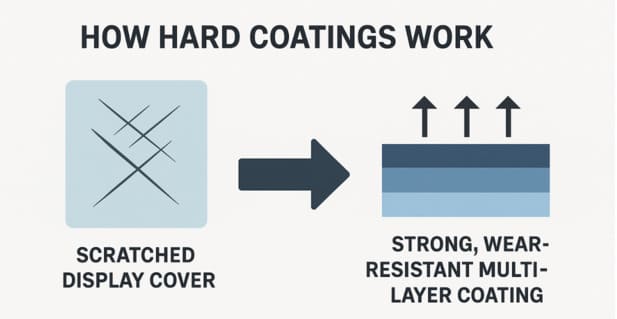 You might think all hard coatings provide the exact same basic protection for your screen panels. This dangerous assumption will cost your factory thousands of dollars in rejected parts. I will explain exactly how to upgrade your coating strategy right now.
What is the real difference between normal and high wear-resistant coating grades?
Your standard coated plastic cover scratches fast in tough outdoor environments. You lose money replacing broken parts daily. You must know when to upgrade surface protection completely.
Normal hard coating uses a single silicone or acrylic layer for basic touch screens. High wear-resistant grades use multi-layer composites or nano-particles like silicon dioxide. These enhanced layers give maximum protection for outdoor equipment and heavy heavy-duty industrial displays.
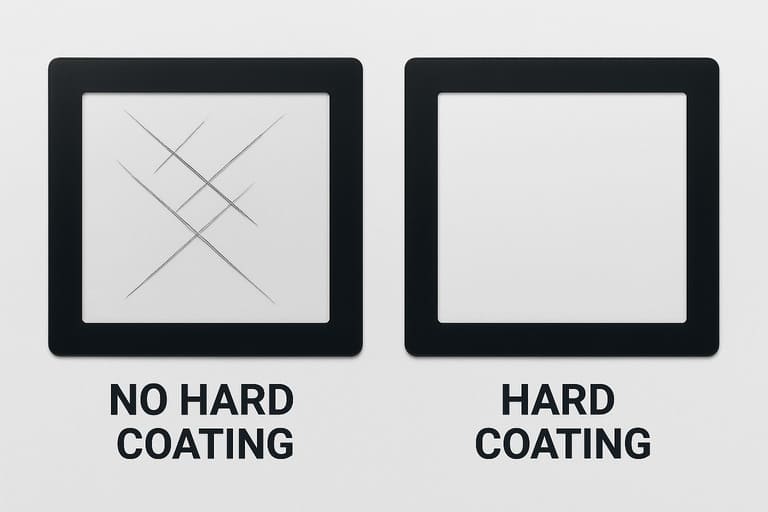
As a factory founder at VIIST, I clearly see why standard chemical coatings fail outdoors. Basic hard coatings only add one single chemical layer. We use normal silicone or acrylic materials here. We put this simple layer on daily mobile touch screens. We use it for basic indoor display covers. This single layer works perfectly for gentle indoor touches.
Why do tough environments need nano-particle upgrades?
However, heavy industrial displays require much stronger chemical armor. We must use high wear-resistant coating grades for absolute safety. We build complex multi-layer structures. We inject tiny nano-particles deeply into the chemical mix. We mostly use silicon dioxide for this. These tough nano-particles create a heavy shield against sharp dirt and metal tools. We also apply flexible hard coatings for brand new foldable screens. The plastic needs to bend safely completely without breaking the hard armor.
| Coating Grade | Core Material Structure | Best Application Environment |
|---|---|---|
| Normal Hard Coating | Single silicone or acrylic layer | General daily touch screens |
| High Wear-Resistant | Multi-layer composite with nano-particles | Outdoor machines, industrial panels |
| Flexible Hard Coating | Bendable advanced chemical resins | Foldable devices, flexible displays |
You must analyze your product location deeply before you order. Use a normal grade to save money indoors. Always choose a nano-enhanced high wear grade for public outdoor screens.
How do we actually apply these different hard coatings onto your plastic substrates?
Your coating thickness looks totally uneven. You waste expensive raw liquid materials daily. You must pick the exact right coating method for your specific product shape.
We use five main processes to coat plastics. Flow coating works best for large flat boards.1 Dip coating covers complex 3D shapes.2 Spray coating handles curved surfaces. Spin coating creates ultra-precise thin films for optics.3 Slot-die coating offers total precision for uniform substrates.4
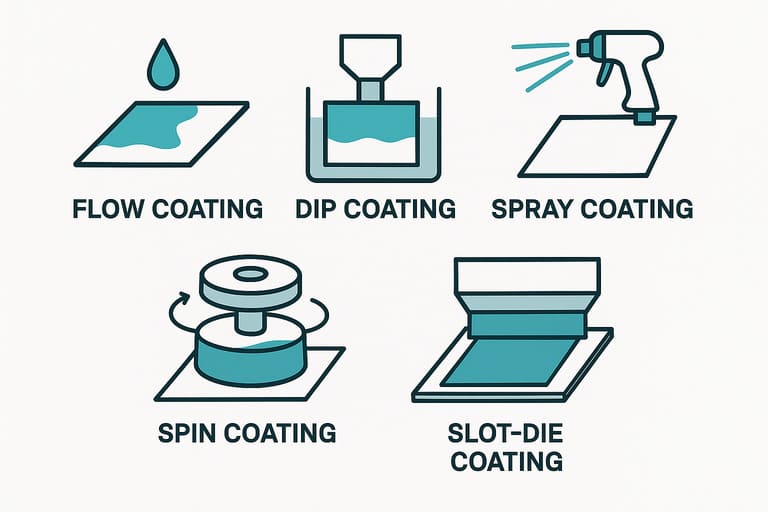
I learned the importance of liquid application techniques early in my optical manufacturing career. The wrong method wastes expensive chemicals instantly. We use flow coating for big flat PC panels. The liquid falls exactly like a waterfall curtain over the plastic board. This method is incredibly fast. It is highly cost-effective naturally. But we cannot use flow coating for weird complex shapes.
How do we handle complex 3D parts and precision optical lenses?
We use dip coating for those complex molded parts. We dip the raw 3D plastic piece directly into a deep liquid bath. We pull it up at a very slow steady speed. This covers every hidden corner perfectly. We use spray coating for curved screens. Compressed high-pressure air pushes the chemical liquid out smoothly. We use spin coating for tiny camera dome covers. A fast spinning circle pushes the liquid flat. This spin method gives us an extremely even film. But it wastes a lot of raw material. Finally, we use high-end slot-die coating for premium flat displays. A precision metal tool squeezes the liquid out perfectly.
| Application Method | Process Action | Ideal Product Type |
|---|---|---|
| Flow Coating | Liquid curtain drops down | Large flat PC/PMMA boards |
| Dip Coating | Submerge and pull up slowly | Complex 3D security visors |
| Spray Coating | High pressure air spray | Normal curved display parts |
| Spin Coating | Fast rotational force | High precision optical lenses |
| Slot-Die Coating | Extrusion through a precision mold tool | Premium flat uniform displays |
Always ask your factory supplier about their exact coating method. The right process lowers your final cost and improves visual clarity at the same time.
Does the chemical curing method really change the final scratch resistance of the product?
Your newly made coating scratches completely. You pushed the factory to work too fast. You must understand how the curing heat directly changes bare material hardness.
The curing method heavily impacts total scratch resistance immediately. Slow thermal baking creates a much harder surface than fast UV light curing. UV curing takes only seconds and stops heat damage. Thermal curing takes hours but delivers ultimate physical strength and tough armor for the plastic.
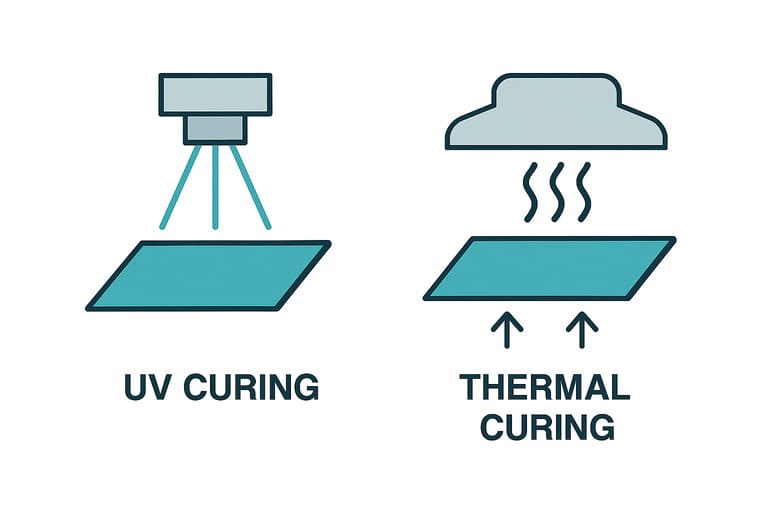
Many clients ask me to speed up their production orders. They want ultra-fast UV curing for every single product. I always warn them about the physical trade-offs. The curing process hardens the wet liquid chemical into a solid dry shield. How we harden it matters completely for your item.
Why does slow thermal baking beat fast UV light curing?
Thermal curing requires a large industrial baking oven. We must bake the coated plastic for tens of minutes. Sometimes we bake it for several full hours. This slow heat creates very strong chemical bonds deep inside the coating. The final surface hardness is much stronger than a UV-cured surface. We always use slow thermal curing for tough outdoor security domes. But extreme heat melts special heat-sensitive plastics easily.
We use UV light curing when we absolutely cannot use heat. UV light hardens the liquid chemical in just a few seconds. This cold fast process protects sensitive device parts easily. But UV curing only works with light-sensitive chemicals. True UV light cannot pass through dark opaque plastics.
| Curing Method | Processing Time Requirement | Heat Level | Final Physical Hardness Result |
|---|---|---|---|
| Thermal Curing | Long (minutes to hours) | Very High | Excellent, superior deep strength |
| UV Light Curing | Very Fast (seconds) | Very Low | Good, slightly softer outer surface |
You must choose heavy thermal curing for extreme wear protection. You should only use UV light curing for fast indoor jobs.
How do we accurately test the hard coating and where do we use it daily?
You cannot guess your screen quality safely. You worry about customer returns entirely. You must demand strict factory testing to prove the hard coating truly works.
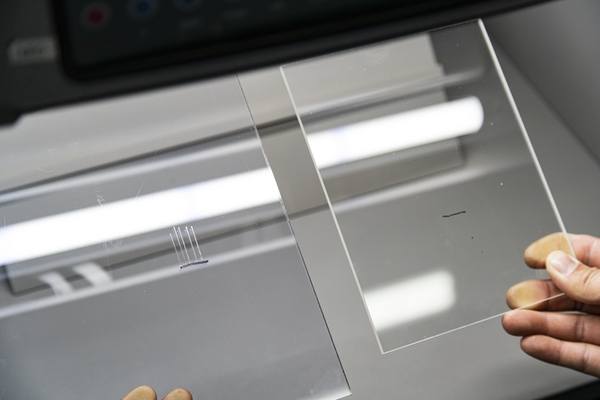
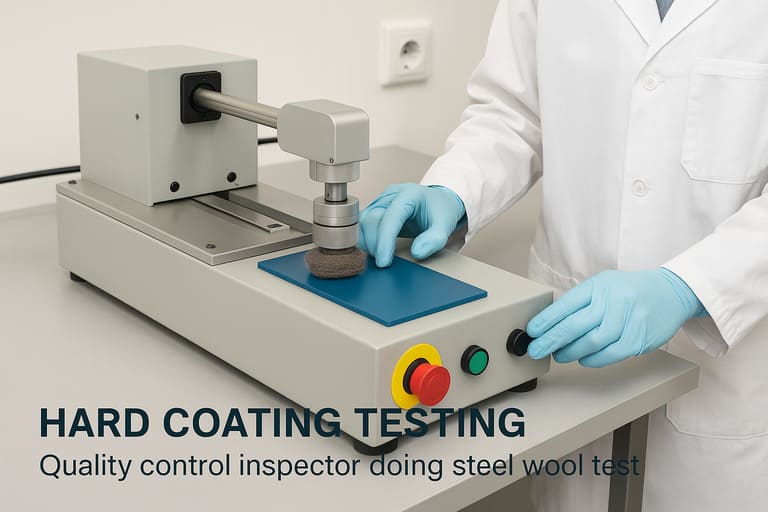
We use strict ISO standards to measure exact hardness. We scratch the surface with graded 9H pencils. We rub the coating with steel wool under heavy pressure. We grind it loudly with Taber abrasive wheels. These hard coatings protect safety goggles, car dashboards, and public retail displays daily.
How do we destroy samples to prove their extreme strength?
The pencil hardness test is the absolute fastest daily method. We push different pencils across the flat coating. We start from soft 6B leads. We go up to extremely hard 9H leads. We easily find the exact hardness limit before the entire surface breaks. We also use the rough steel wool friction test. We press sharp #0000 steel wool right onto the plastic. A machine rubs it back and forth many times under a heavy weight constraint. We check extremely closely for any new scratches. Finally, we run deep Taber abrasion tests. A rough spinning stone wheel grinds the surface constantly. We measure the total lost mass exactly.
| Test Method Name | Testing Tool Applied | Core Measurement Goal |
|---|---|---|
| Pencil Hardness | Graded pencils (6B to 9H) | Finds direct scratch breaking point quickly |
| Steel Wool Rub | #0000 sharp steel wool | Checks heavy friction damage limits |
| Taber Abrasion | Rough spinning stone wheels | Measures mass loss and haze change exactly |
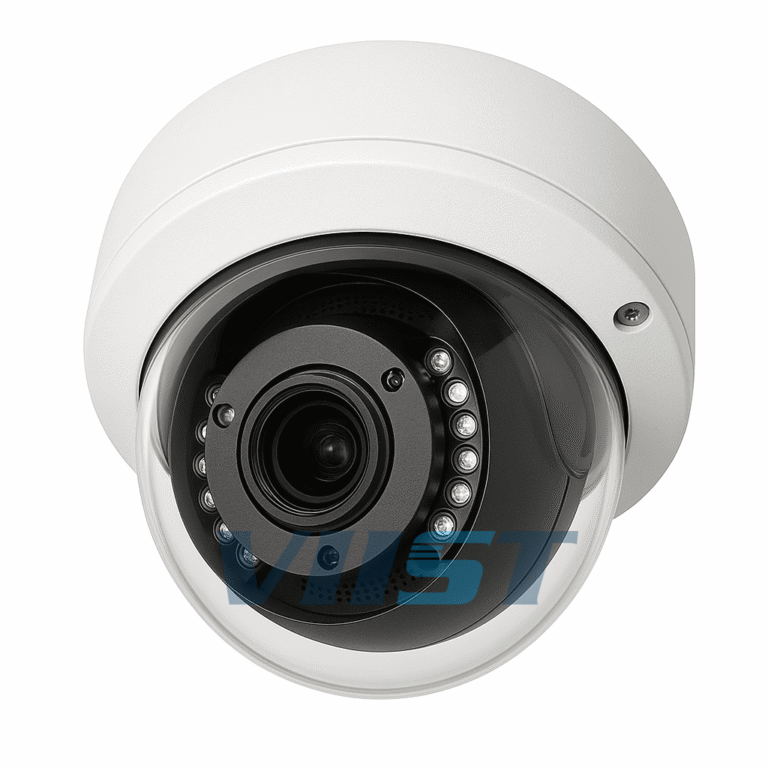
We put these tough coatings everywhere outside. They protect chemical worker safety goggles perfectly. They keep bright car dashboards completely clear. They stop criminals from blinding security cameras instantly. You must demand these tough lab tests directly from your supplier.
You must match your hard coating grade, application exact process, and specific curing method accurately. Strict factory pencil and friction testing ensures true scratch physical protection for your clear plastic products.
"Coating Techniques for Adhesives | MasterBond.com", https://www.masterbond.com/applications/typical-coating-techniques. Coating-process references describe flow coating as a liquid-over-surface method suited to coating relatively large, flat or gently contoured substrates; this is process-level support and does not determine the best method for every production line. Evidence role: general_support; source type: education. Supports: Flow coating is well suited to large flat plastic boards.. Scope note: The phrase “works best” depends on part geometry, viscosity, equipment, cost, and quality requirements. ↩
"The Thickness and Structure of Dip-Coated Polymer Films in ... - PMC", https://pmc.ncbi.nlm.nih.gov/articles/PMC9318159/. Technical descriptions of dip coating state that immersion and controlled withdrawal can coat all exposed surfaces of a substrate, making the method applicable to parts with non-planar geometry; this is general process support and uniformity still depends on drainage, viscosity, and withdrawal speed. Evidence role: mechanism; source type: education. Supports: Dip coating can cover complex three-dimensional parts.. Scope note: Dip coating may not coat enclosed cavities uniformly and can suffer from runs or thickness gradients. ↩
"Spin coating - Wikipedia", https://en.wikipedia.org/wiki/Spin_coating. Microfabrication and thin-film references describe spin coating as a method for producing thin, relatively uniform films on flat substrates by centrifugal spreading; this supports its use for precision thin films but is contextual for optical parts specifically. Evidence role: mechanism; source type: education. Supports: Spin coating creates precise thin films suitable for optical applications.. Scope note: Spin coating is most applicable to flat or rotationally symmetric substrates; it may not suit all optical geometries. ↩
"Slot-die coating - Wikipedia", https://en.wikipedia.org/wiki/Slot-die_coating. Research and technical reviews of slot-die coating describe it as a pre-metered coating method capable of producing controlled wet-film thickness across moving substrates; this supports high thickness control, while “total precision” overstates what the method can guarantee. Evidence role: mechanism; source type: paper. Supports: Slot-die coating provides high thickness control and uniformity on suitable substrates.. Scope note: Precision depends on rheology, die design, web handling, and process conditions; no method provides perfect uniformity. ↩